Basic Raw Editing


                Shooting in RAW is always preferred by most of the photographers. RAW file is like digital negative, thus making post processing flexible and powerful and compared to editing JPEG. I use Nikon D7000 and Adobe Photoshop CS5. Other models and version can make concerned changes in the post and read. In this post I will try to explain some basic steps in RAW editing using Adobe Photoshop CS5. Before starting, here are few notes:
1. Check if you have installed proper camera raw plugin. Look in the associated equipment list for your camera model.
2. A particular version of Photoshop supports camera raw, and is mentioned in the details of the camera raw version u r downloading.


Tool pallet helps for cropping, rotating and zooming the image.  Tool pallet 2 is more useful. Histogram and EXIF information is displayed on the top. Just below it, there are plenty of tabs which are used for adjustments. First tab, Basic, is widely useful. White balance can be adjusted using some pre-sets and fine tuning can be done with temperature and tint slide bars. I use it mainly for correcting object colors due to light reflection from other objects. Exposure adjustments helps specially when the flash has not fired, I have explained it in detail here. Default values of recovery, fill light, blacks and brightness slide bars are acceptable in most situations. Contrast may be sometime improved. I don't seem it add much of the noise. Clarity adjustment may be individual taste. For macro (close-up photos) sometimes I decrease the value. Rarely I increase it. For sharpening I use "high pass filter technique". Increasing saturation increase vividness. I shoot the photos at standard picture settings. So sometimes hue and saturation are necessary. Other tabs, sometime later. Basic tab suffice most needs. :-)


Flowering Trees: Bixa orellana (शेंदरी)


Flowers
A small evergreen tree, originating from Myanmar / Burma). Flowers in October to December. Flowers with five petals and are off-white / pinkish in color, approx. 6 cm in diameter. Flower occurs in a bunch at the end of the branch. This tree is cultivated variety in India, although its native from Burma. The seeds are crushed to obtain yello-orange pigments and are used as dye for food, cosmetic and soap industries. Coloration property of the seeds might be reason it is also called "lipstick Tree". It is reported host plant of Tricolor Pied Flat.

Quick Facts:
Common Name: Lipstick Tree / Annatto
Botanical Name: Bixa orellana
Family: Annatto
Marathi Name: शेंदरी
Location on IITB campus: Medical garden, many of them planted left side of entrance.

Plant
Seeds


Flowering Trees: Saraca asoca ( सीता अशोक )

Flowers of Sita Ashok
Leaves of Sita Ashok
semi tall, sprawling green tree looks like a content and satisfied human being to me. Its the same tree mentioned in Ramayana in referenace to "Ashok Van" (Garden of Ashoka trees), where Sita was captivated by Lankan King Ravan. Its the same place where Hanuman meets her and assures her about her release. Tree grows upto 10 meters and found in evergreen forests. Tree is green through out the year and flowers in pre- monsoon months. This characteristics may be the reason tree becoming a must plantation in garden. Still this tree is listed as "vulnerable to extinction" in the IUCN list. Flowers, yellow-orange colored, bloom in clusters. Personally, I haven't seen nectoring species on this flowers. Although flowers are fragrant, never seen a lady wearing those either. It is reported host plant of Common Cerulean, a common butterfly. 

Quick Facts: 
Common Name: Sita Ashok / Sorrowless tree
Botanical Name: Saraca asoca
Family: Gulmohar
Marathi Name: सीता अशोक
Location on IITB campus: on right side of H-5 entrance


Lime Blue (Chilades laius)


Fresh Lime Blue 

Lime Blue female egg laying on Lime
Lime Blue (Chilades laius) belongs to Lycaenidae family. It is small butterfly, grayish in colorWe were able to observe its life-cycle. As its name suggest its larval host plants includes Lime plants. We observed its larva on small lime tree in Medical garden. Larva was easy to detect even though it is well camouflaged. Ants constantly follow larva, so in order to find Lime Blue's larva just follow the trail of ants. On the same plant we were able to find many empty pupa. This plant had many curled leaves. Lime blue caterpillar took advantage of this to make the pupa. Pupa were well concealed inside curled leaves of plant. It seemed that ants were attaining pupa also. We saw two pupa made very near to each other on same curled leaf. Lime Blue is seemed to be common in immediate post mansoon months. Again they were mainly encountered around Hill side. 


Lime Blue pupa in secluded leaf of lime, held on palm 
Key to ID this butterfly is the "L"shaped dots on its hind wings. Sex are dissimilar, female has black outlines on UP, which are absent in male. Here is a video Describing association of ants with lime blue caterpillar on lime tree.


Quick Facts:
Common Name: Lime Blue
Scientific Name: Chilades laius
Wingspan: approx 25-20 mm
Status: Locally Common.


Lime Blue
Pulpit rock
Female
Pulpit rock
Male
Pulpit rock
Early stage Pupa
Pulpit rock
Early Stage Pupa
Pulpit rock
Pupa just before eclosion
Pulpit rock
Pupa Just before eclosion
Pulpit rock
A different specimen


Flowering Trees: Red Silk Cotton Tree (शाल्मली / शेवर)

Flower of Red cotton silk tree

A large dark red/ magenta colored flower of "silk cotton tree" attracts every nature wanderer during summer trails. There exists a very similar species, white flowers is the sole difference. Flower with five petals blooms during spring months (January to March), while tree losses all its leaves as many other tree do. Many birds like drongo, jungle babbler, common crow etc. feed on the flowers. 


This native tree can grow up-to 30 m. Thorns on the stem and branches is its characteristic ID. Tree is largely famous as it bears its relation with a famous festival of Holi. In Konkan region, the decorated tree, decorated with Mango leaves and flowers, is worshiped.  Tree is then burnt in the night and Holi is celebrated. The availability of this tree is larger and confidently its leafless during the same month when Holi is celebrated. The fruits appear in the month of April may and has fiber inside. Often seen them flying with the hot summer winds. Fibers are used in the pillows by villagers. Wood is light and makes it use in building structures used in water. 

Quick Facts:
Common Name: Red Silk Cotton Tree (Sanskrit: शाल्मली / Marathi: शेवर)
Botanical Name: Bombax ceiba
Family: Baobab
Flowers: Large, red/magenta colored with 5 petals
Location on campus: All over academic area and hill side, a common tree.

Jungle Babbler feeding on Red Cotton Silk Tree


Wandering destination: Tungareshwar WLS


Cool water streams at Tungar WLS

Plum Judy is a commoner butterfly
Stunning destination for nature lovers. IT has something in every season. water falls and flowers in monsoon, butterflies in pre and post monsoon season, charming birds in winter season. Racket tailed drango, Around 100+ species of butterflies can be seen around. Winter season is best for birding. Asian Paradise flycatcher, Verditor are few attractive species of birds found here in appropriate season.

To reach Tungar, take bus from Main gate to Andheri railway station. Frequent locals from Andheri drops u at Vasai road. Take share auto to "Tungar Phata" and then start walking towards WLS. Entrance is at about kilometer inside from the main road. No ticket is charged presently and no permission required for nature walk. One can either follow the water streams or the road. Another part of Tungar WLS is Chinchoti waterfall. Alight  at Naygaon station, catch share auto to reach Chicnhoti fata.

Tungareshwar is famous for the Shiva Temple, which is around 3-4 kilometers from Tungar phata. Fairly good road for vehicles to go till the temple. It is jot advisable to take bikes, specially in and after monsoon season.

Cornellion is common in Monsoon

Morning at Tungar WLS


Video of Water stream, Chinchoti during December

Shiva Temple

Tungar WLS and Chichoti waterfall


Swapnil and Abhay sharing lite moments at Chichoti water fall


Wandering Destination : Matheran


Road to heaven?...Matheran
A famous tourist weekend destination and hill station. Pollution free zone due to some strict rules regarding vehicles and environment. Basically its a plateau at a height of about 1800 mt. Temperature in summer doesn't go above 30 deg.cel. Pretty good destination for photography post-monsoon. Stunning waterfalls,  exquisite landscapes, mesmerizing fog, curvy roads, breath taking valleys, grand panoramas, drizzles, in short everything for memorable weekend. Birds in and after winter is good attraction. We went there for butterflies three times in different season with different approaches. All the three trips proved miserable. Lifers for us was peacock royal sighting. Otherwise the common ones.

Flowering Trees - Cannon Ball Tree ( नागचाफा / कैलासपती)

 
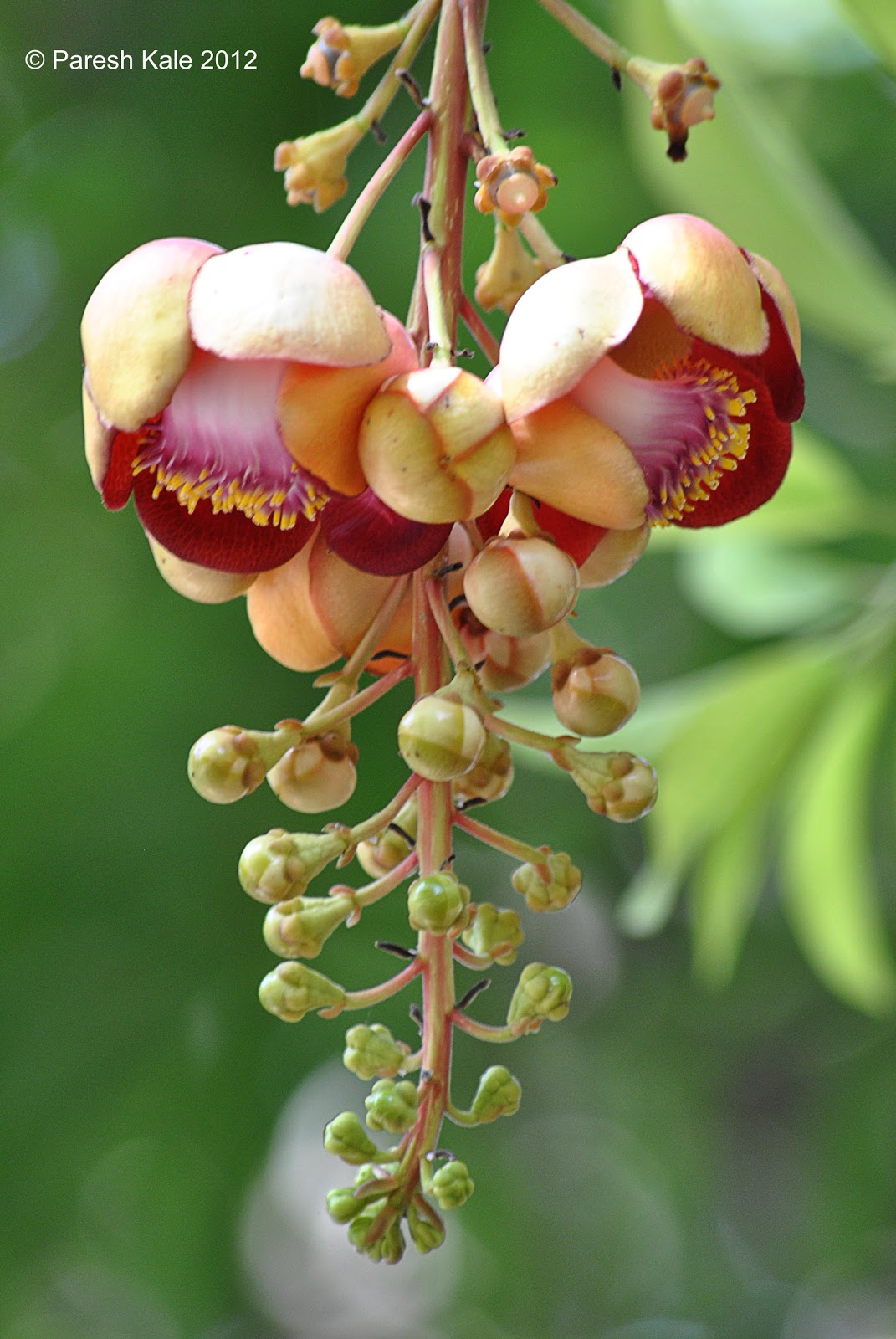
Flower of Canon Ball Tree

Bunch of flowers and fruit string


Second in the flowering Tree series, is the post on "canon ball tree". It is listed as rare tree and flower in India [1]. It grows up-to 80 ft high and flowers in around December. Flower has six petals. Reddish inside and yellowish outside. Tremendously aromatic and smell can be felt strongly in near-by area. Inside structure is horizontal "U" shape. This inner structure is the reason it is offered to Lord Shiva and hence name in Marathi, as some thinks.

This Brazilian native takes its English name due to characteristic canon-ball like shape of its fruits. Fruits have rusty colored hard shell and are heavy. Number of fruits are connected in string and tree bears them directly to the trunk. The Cannonball Tree possesses antibiotic, anti-fungal, antiseptic and analgesic qualities [2] and hence used for medical purpose.

Quick Facts:
Common Name: Canon Ball Tree
Botanical Name: Couroupita guianensis
Family: Barringtonia
Marathi Name: कैलासपती / नागचाफा/ नागलिंग
Location on campus: Only one in parking lot near staff club.


Flower close-up
Ref:
1. http://www.flowersofindia.in/catalog/slides/Cannon%20Ball%20Tree.
2. http://en.wikipedia.org/wiki/Couroupita_guianensis

Flowering trees - Cassia fistula (बहावा)


grape bunches-like flowers
IIT Bombay hots many flowering trees, which are unusual to find in Mumbai city. This is the first article in the series of "flowering trees". The series will be covering details about some of impressive trees present on the campus. 

Tree for today is Cassia fistula, commonly known by Amaltaas / Golden shower tree or Indian Laburnum [1]. In Marathi it is named as 'Bahava' (बहावा). In Ayurvedic medicine, golden shower tree is known as aragvadha, meaning "disease killer" [2]. Its a tropical ornamental tree, may reach up-to 50 feet height. It is host plant LHP for Common emigrant and Mottled emigrant butterfly species. 

Golden shower tree is obvious name due to bright and cheerful display by thousands of fragrant small flower. Pendant like (grape bunches-like) bouquet of golden colored yellow flowers are eye catching. These flowers are attractive to bees and butterflies [1]. Flowering season for the tree is in the months of March to May. Sometimes the tree is seen without a single leaf when flowering. The golden shower tree is the national flower Thailand; its yellow flowers symbolize Thai Royalty [2]. Its also state flower of Kerala. A postal stamp was issued by the Indian Postal Department to commemorate this tree. 


Quick Facts:
Botanical Name: Cassia Fistula
Family:  Gulmohar
Flowering season: Late spring
Location on campus: Out side DRDO and QIP quarters.


Small Bahava Tree


Reference: 

Wandering destination: Around Mumbai


Greater Flamingo at Shivadi


IIT Bombay campus hosts innumerable varieties of birds, flowers, trees and butterflies. However, it has natural and ecological limitations. Every living species around Mumbai cant be seen in the campus. Some of the species are jungle dwellers and prefers thick, unattended forest. For example some butterflies species like Baronet, Tinsel, Western centaur Oakblue are seen in the jungles of SGNP and Tungareshwar WLS but IITB Campus. To explore more wonders about nature, apart from campus, there are some immediate destinations near Mumbai sub-urban. Here is consolidated information about one-day return spots.

Lungs of Mumbai, SGNP
Sanjay Gandhi National Park (SGNP): Campus shares some of its boundaries with SGNP. SGNP, a  protected are of about 104 sq. km., spreads from Borivali to Thane.  An estimated 800 types of flowering plants; 284 kinds of birds; 5,000 species of insects; 36 types of mammals; 62 reptiles and 150 species of butterfly can be found. some distinguished features of the park are nature trails, Karvy flowers blooming after every 7/8 years, Kanheri caves. Ticket for individual is 20 Rs and park can be accessed from 6 AM to 6 PM. From IIT, BEST or NMMT buses drops you at the very entrance of the park. Private vehicles are allowed inside the park with some fees. For trekking and nature trails, prior permission is required.

Jungles in SGNP


Shiwadi bird watching spots
Shivadi: Famous for Flamingo's. Many other water birds (gulls, waders, snipers, herons,etc) can be seen in the mangrove forest. Best time of the day would be morning to visit. The are plenty of spots to seat calmly and watch bird activities. Take a train from Kanjur to Shiwadi, with one change over at Dadar. Start walking towards sea coast and ask for Jetty. Jetty is the best spot among many. Siwari fort could be an attraction for some, Colgate gate is another point to watch birds closely.  


Yeoor Hills: This is entry to SGNP from Thane. Buses from IIT Main gate to Mulund and then catching bus towards yeoor takes about 45 minutes to reach the destination under normal circumstances.


Tata power plant at backdrop, Shivadi

Map of Nagla Block
Nagla: Another extension of SGNP. Its far from the disturbances by the tourists. For butterfly lovers, there can be few surprises post monsoon season. Some exotic species of butterflies like Silver streak Blue, Chocolate Albatross, Orange Awlet, Acacia Blue are often sited. To reach Nagla, take a bus from Main gate to Mulund and then from Mulund to Hotel Fountain. Walk about a kilometer towards Ahmedabad on the highway and there u are. On right side there are some houses and thats the way in to the Nagla block.

Mahim Nature Park: Situated in the midst of city and spread over a large area on the banks of Mithi. Very well maintained and can be good starting point to watch nature closely and comprehensively. It hosts every natural element : birds, butterflies, flowers.Entry fee is 10 rs. Permission required to take photos. A bus from Gandhinagar bus stop drops very near to MNP.


By Paresh Kale